FREE DEMO DOWNLOAD
Install the VST3, load it in your DAW and start playing. Without a license, RED CROWN automatically runs in TRIAL mode.
DOWNLOAD FREE DEMOSTEVE SLEDGE PRESENTS
A complete stereo guitar amp rig — booster, British Amp Normal Channel, four-band EQ, output-stage character and speaker simulation.
VST3 · Windows · Version 1.0.0 · One-time purchase
ONE PLUGIN. THE WHOLE SIGNAL CHAIN.
Plug in. Hit it hard. Let that sucker howl.
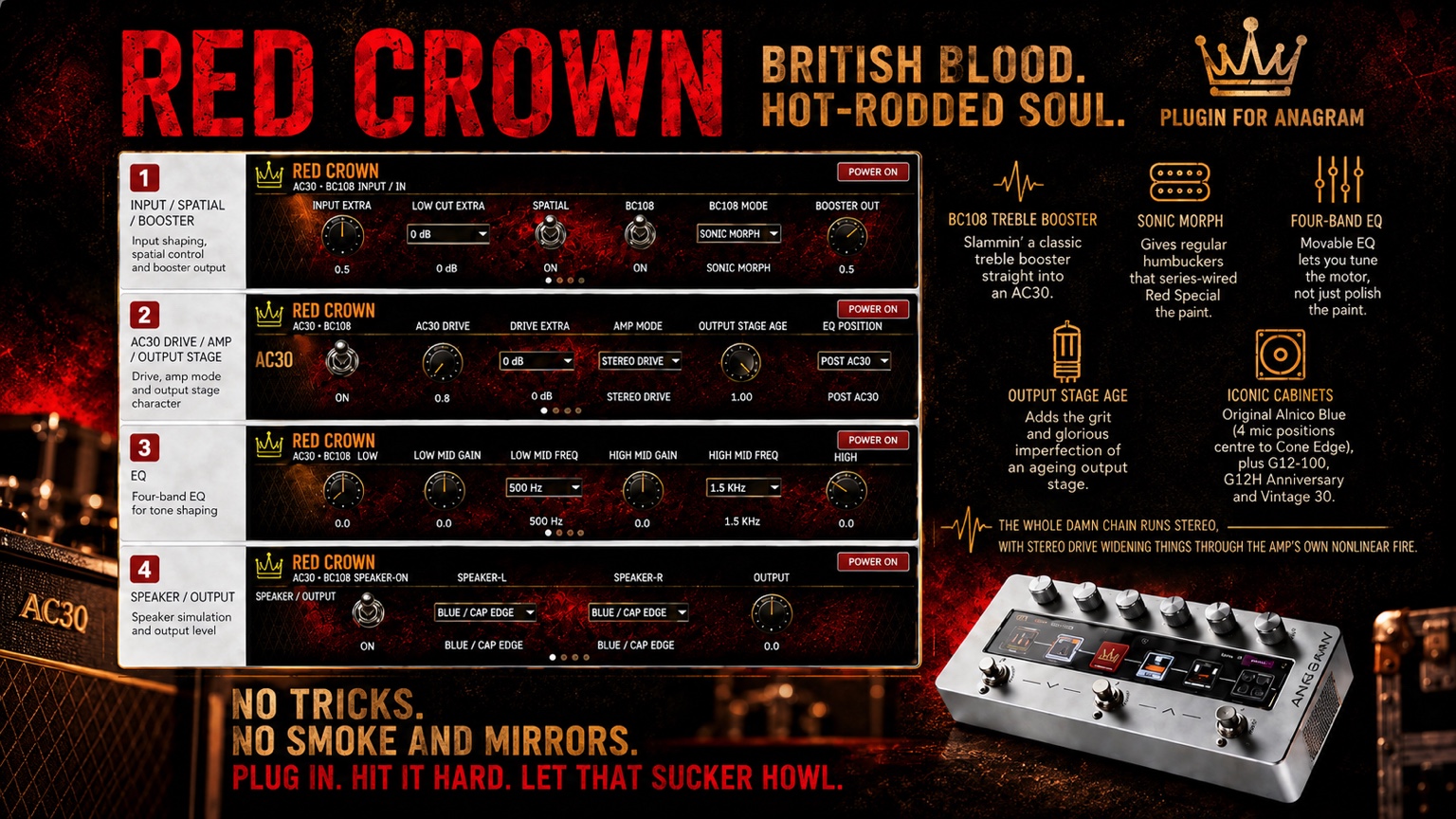
Download RED CROWN VST3 for Windows and try the same core modelling and feature set before you buy. No account or license is required for the demo.
Install the VST3, load it in your DAW and start playing. Without a license, RED CROWN automatically runs in TRIAL mode.
DOWNLOAD FREE DEMOThe demo uses the same core algorithm and controls. In TRIAL mode, audio is muted for 5 seconds in every 30-second cycle. Importing a valid RED CROWN license removes the interruption.
A short visual introduction to RED CROWN and the complete plugin concept.
THE RED CROWN SIGNAL CHAIN
RED CROWN is built as a complete guitar amp rig rather than a collection of separate effects. Shape the pickup response, push the BC108 Booster, drive the British amp section, place the EQ where it works best, choose the speaker character and open the result into stereo.
RED CROWN’s BC108 Booster is a dedicated nonlinear transistor model, designed to drive the amp rather than act as a simple level boost. TREBLE delivers the classic focused BC108 response, while LINEAR uses a neutral voicing. SONIC MORPH morphs the response of a modern humbucker with the LINEAR Booster into the distinctive character of Red Special-style series-wired pickups with the legendary treble booster.
At the heart of RED CROWN is its British Amp model. DRIVE determines how far the complete multistage amplifier is pushed — from a more open, dynamic response into increasingly rich and complex valve overdrive.
Because the amplifier is modelled as interacting nonlinear stages rather than a single distortion curve, increasing DRIVE changes more than the amount of distortion. Pick attack, playing dynamics and signal level all influence how the amplifier responds and how its harmonic character develops.
The harder you play it, the more the amp reveals its character.
OUTPUT STAGE AGE is inspired by the changing behaviour of a classic cathode-biased push-pull output stage as its cathode-bypass capacitor ages. As the bypass becomes less effective, more signal-dependent voltage develops across the shared cathode resistor, dynamically shifting the output-stage bias and changing the behaviour around the push-pull hand-over.
Red Crown does not simulate the ageing capacitor itself. Instead, OUTPUT STAGE AGE models the resulting change in crossover behaviour, from NEW (0.1) to WORN (1.0). The effect is level-dependent and becomes part of the nonlinear response of the power stage rather than acting as a separate distortion effect.
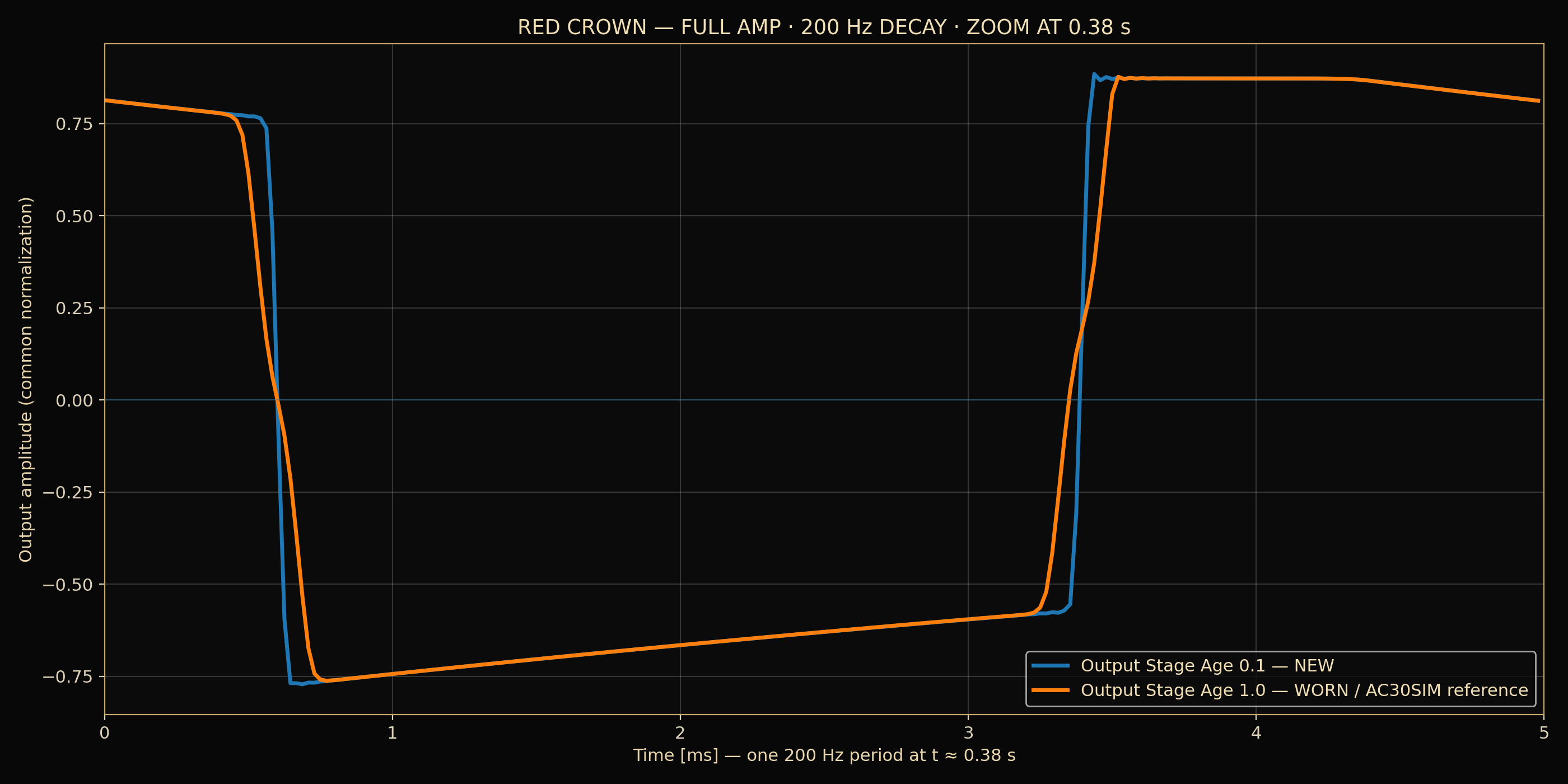
OUTPUT STAGE AGE — FULL AMP MODEL. NEW (0.1) and WORN (1.0) show the two extremes of the modelled push-pull crossover behaviour within the complete Red Crown Amp model.
The four-band EQ can be inserted PRE BOOSTER, PRE AMP or POST AMP — so it can shape what drives a nonlinear stage or simply contour the finished amp tone. A 120 Hz low shelf, selectable 250/500/1000 Hz low mids, selectable 750/1500/3000 Hz high mids and a broad 700 Hz high shelf all run at Q 0.7 with ±12 dB range.
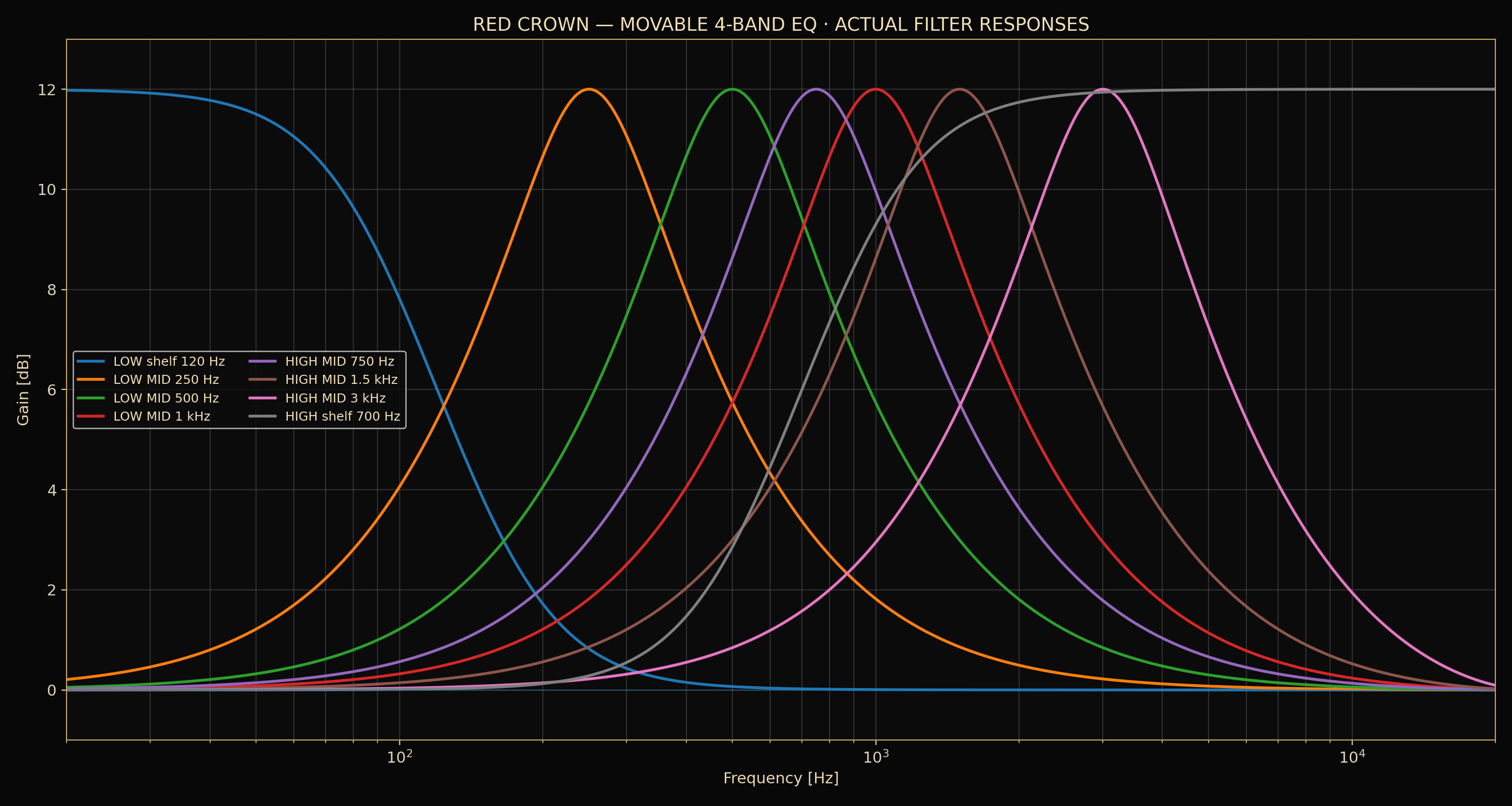
ACTUAL EQ FILTER RESPONSES. Calculated directly from the current Red Crown EQ implementation at +12 dB: 120 Hz low shelf, selectable 250 / 500 / 1000 Hz low mids, selectable 750 / 1500 / 3000 Hz high mids, and 700 Hz high shelf. Q = 0.7; each band provides ±12 dB of gain.
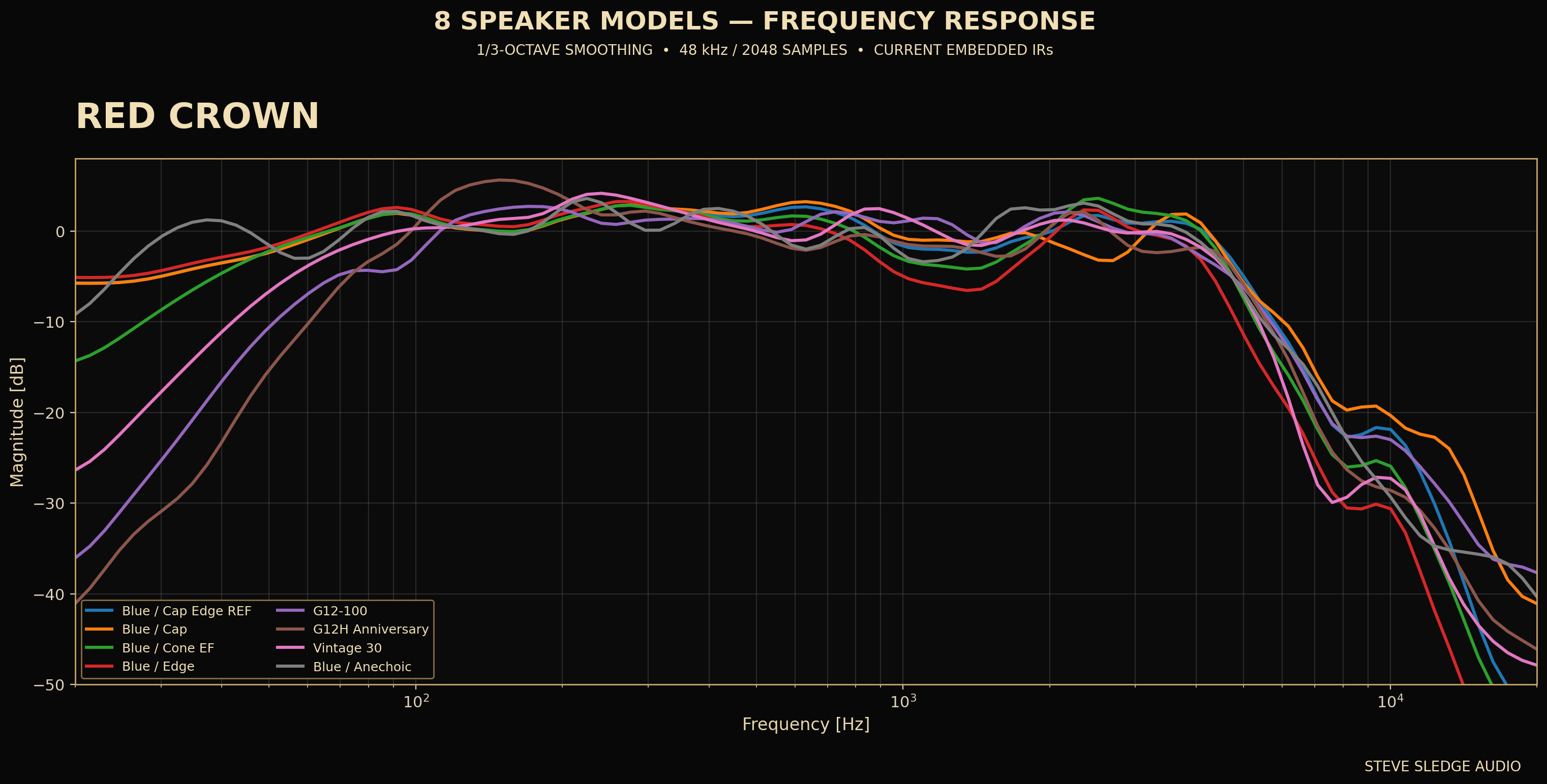
Choose from eight carefully crafted speaker voices: Blue (Cap Edge REF), Blue (Cap), Blue (Cone EF), Blue (Edge), G12-100, G12H Anniversary, Vintage 30, and Blue (Anechoic).
The speaker section uses embedded 2048-sample impulse responses with efficient fast convolution to capture the tonal character and response of each speaker. All voices are carefully level-matched to the Blue (Cap Edge REF) reference.
INDEPENDENT STEREO SPEAKER MODELS. Left and right speaker models can be selected independently, allowing different cabinet/speaker combinations on each side of the stereo signal path.
FOUR VIRTUAL MIC POSITIONS. The Blue speaker provides four distinct microphone perspectives: Blue (Cap Edge REF), Blue (Cap), Blue (Cone EF) and Blue (Edge). Cap Edge preserves the original reference response, while the other three positions are derived relative to that reference using a physically motivated model of the loudspeaker diaphragm and microphone position . This provides the tonal variation of moving a microphone across the speaker — from cap to edge — while keeping the original Blue reference intact.
Four carefully selected mic positions — instantly recallable, without the guesswork of continuously variable mic positioning.
Red Crown runs true stereo from input to output. STEREO DRIVE adds natural left/right separation within the amp, while SPATIAL opens the sound into a wider, more realistic listening space.
Especially on headphones, the amp no longer feels trapped between your ears. The sound seems to step outside the headphones, creating the impression that the amplifier is actually playing in front of you in the room.
The effect remains natural and unobtrusive — no obvious chorus, no artificial swirl, no distracting echo.
Put on headphones — and the amp feels like it is out there, not inside your head.
At the heart of Red Crown is a deliberately simple valve-amplifier architecture: an ECC83 (12AX7) triode preamp stage feeding a triode phase splitter, followed by a four-EL84 push-pull power stage and output transformer, operating without global negative feedback.
There is deliberately no tone stack within the amplifier circuit. This avoids the frequency-dependent phase shift introduced by a conventional passive tone network before subsequent nonlinear stages, keeping the signal path direct and the distortion behaviour of the individual valve stages more clearly defined.
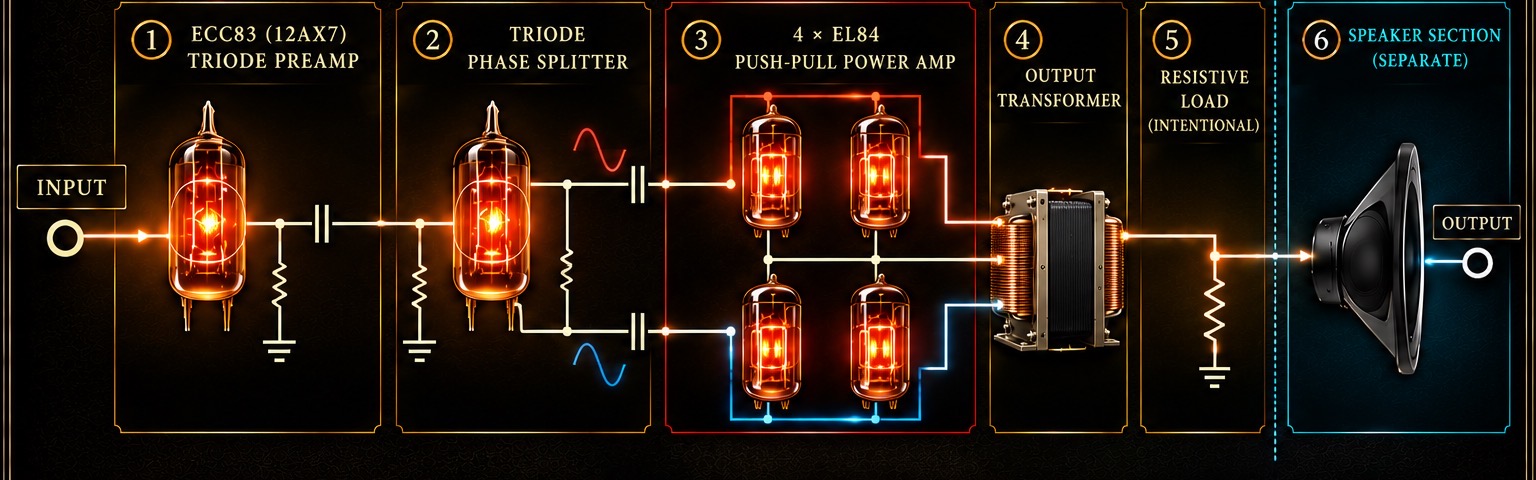
Rather than treating the amplifier as a single distortion block, Red Crown models the behaviour of these individual stages and their interaction as DRIVE increases — from the input triode through the phase splitter to the heavily driven EL84 power stage and output transformer.
4× INTERNAL OVERSAMPLING. All nonlinear modelling stages — including the BC108 Booster and British Amp — are processed at 4× the host sample rate to keep aliasing effectively inaudible while maintaining efficient real-time performance.
The output stage is intentionally modelled driving a resistive load. This keeps the nonlinear behaviour of the amplifier and output transformer separate from the frequency-dependent impedance interaction of a particular loudspeaker. Speaker character is added independently in Red Crown's dedicated speaker section.
This separation was also a deliberate tonal choice: I preferred the character of the driven power stage into a resistive load, while gaining the freedom to change speaker models without changing the underlying power-amp behaviour.
No tone stack. No global negative feedback. Four EL84s, an output transformer and a deliberately resistive load.
Neural Amp Modeling has shown how accurately complex tube-amp behaviour can be reproduced. Red Crown takes a different route — so during development we compared both approaches against the same circuit-level reference.
The reference is a detailed MNA simulation of the British valve-amp circuit. NAM is not the target Red Crown is fitted to; it is an independent benchmark. This lets us compare a compact real-time amp model and a modern data-driven capture against the same underlying amplifier behaviour.
The comparison is deliberately not reduced to a single score. Time-domain behaviour, spectral differences and the critical push-pull crossover regions are evaluated separately. In the latest CROSSWIN development, Red Crown intentionally trades a small amount of global spectral score for substantially closer reproduction of the short crossover transitions.
Both approaches can reproduce the reference remarkably closely. But Red Crown has one fundamental advantage for a playable amplifier: it isn't a fixed capture. The amp remains live, efficient and fully adjustable in real time.
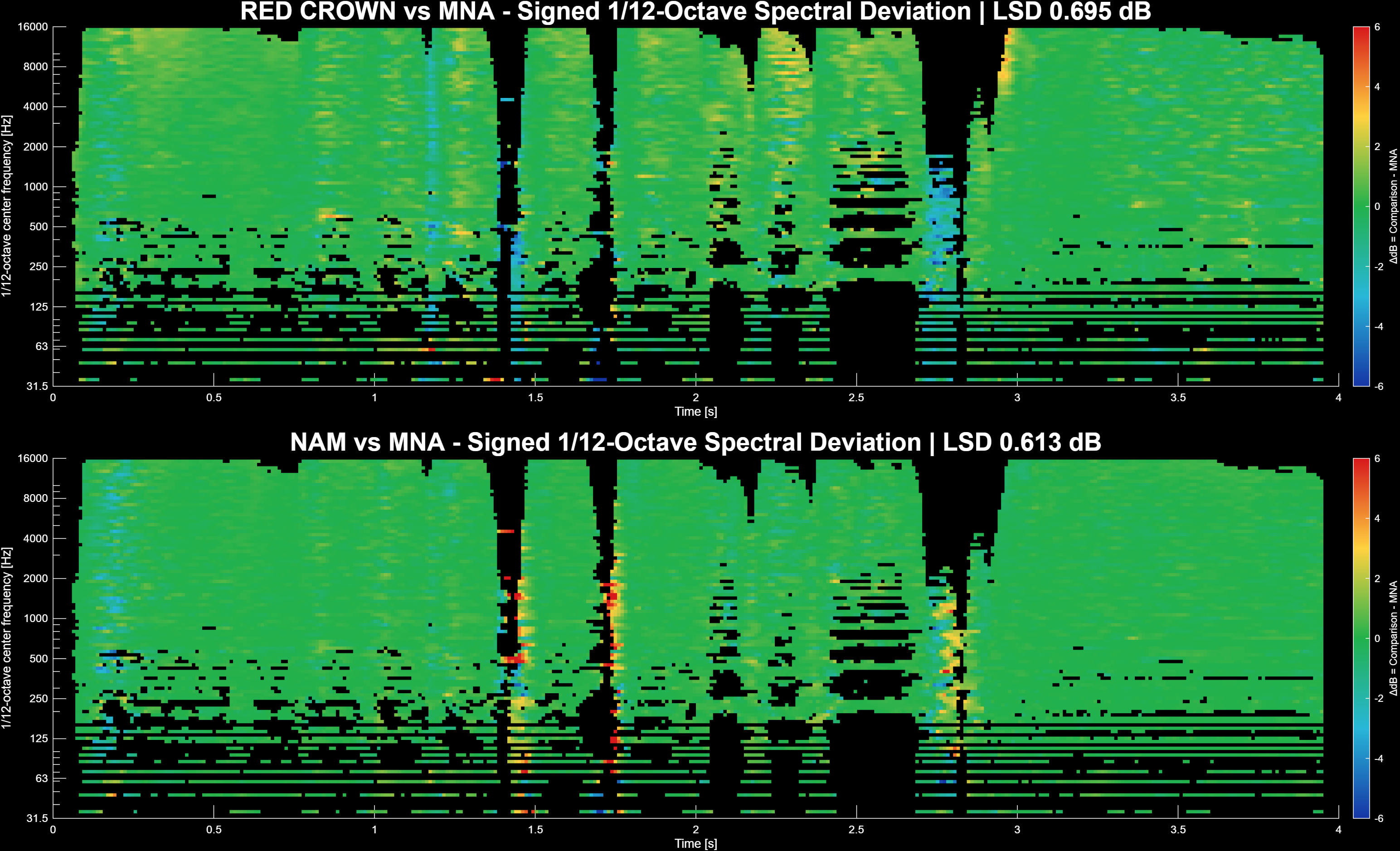
A NAM capture represents an amp state.
RED CROWN models the amp — and lets you change it.
The BC108 Booster is rooted in the classic single-transistor treble-booster tradition — a deceptively simple circuit concept that became an important part of the British guitar sound of the late 1960s and 1970s, particularly when paired with driven valve amplifiers.
Its appeal was never simply “more treble”. The transistor stage shapes the spectrum while adding its own nonlinear character, driving the following amplifier harder and producing a focused attack, additional harmonics and the distinctive gritty edge associated with classic treble-booster circuits.
The BC108 Booster is modelled as a detailed nonlinear transistor circuit, not as a generic drive curve. Mode-dependent capacitor values shape its TREBLE and LINEAR characters. The circuit view below shows the analog structure behind the model.
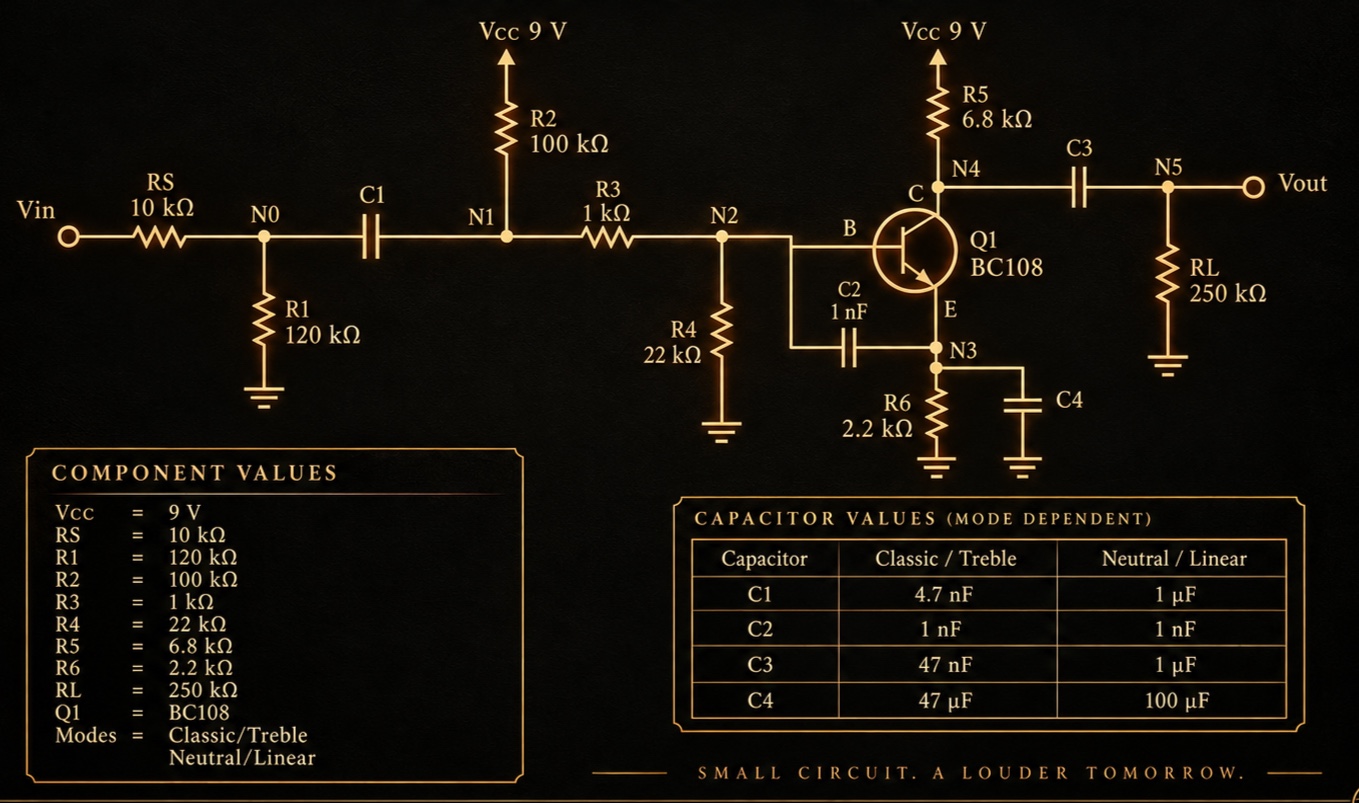
An oscilloscope-style view of the signal through the BC108 Booster — a direct visual look at how the modelled booster circuit shapes the waveform.
A deeper technical explanation of the booster model and the circuit behaviour behind it — for players who want to see more than a generic distortion curve.
The curves below are calculated from the eight current embedded speaker impulse responses used by Red Crown. They are shown with 1/3-octave smoothing for a clear comparison of their overall tonal character.
SIGNAL FLOW
The BC108 Booster remains its own nonlinear stage, while STEREO DRIVE creates additional left/right differentiation within the amp processing. The four-band EQ can move to three useful points in the chain, changing what hits the booster, what hits the amp, or shaping the driven amp signal. After the speaker stage, SPATIAL opens the finished sound into a wider, more natural listening space — especially on headphones, where the amp can feel as if it is playing outside the headphones and in front of you.
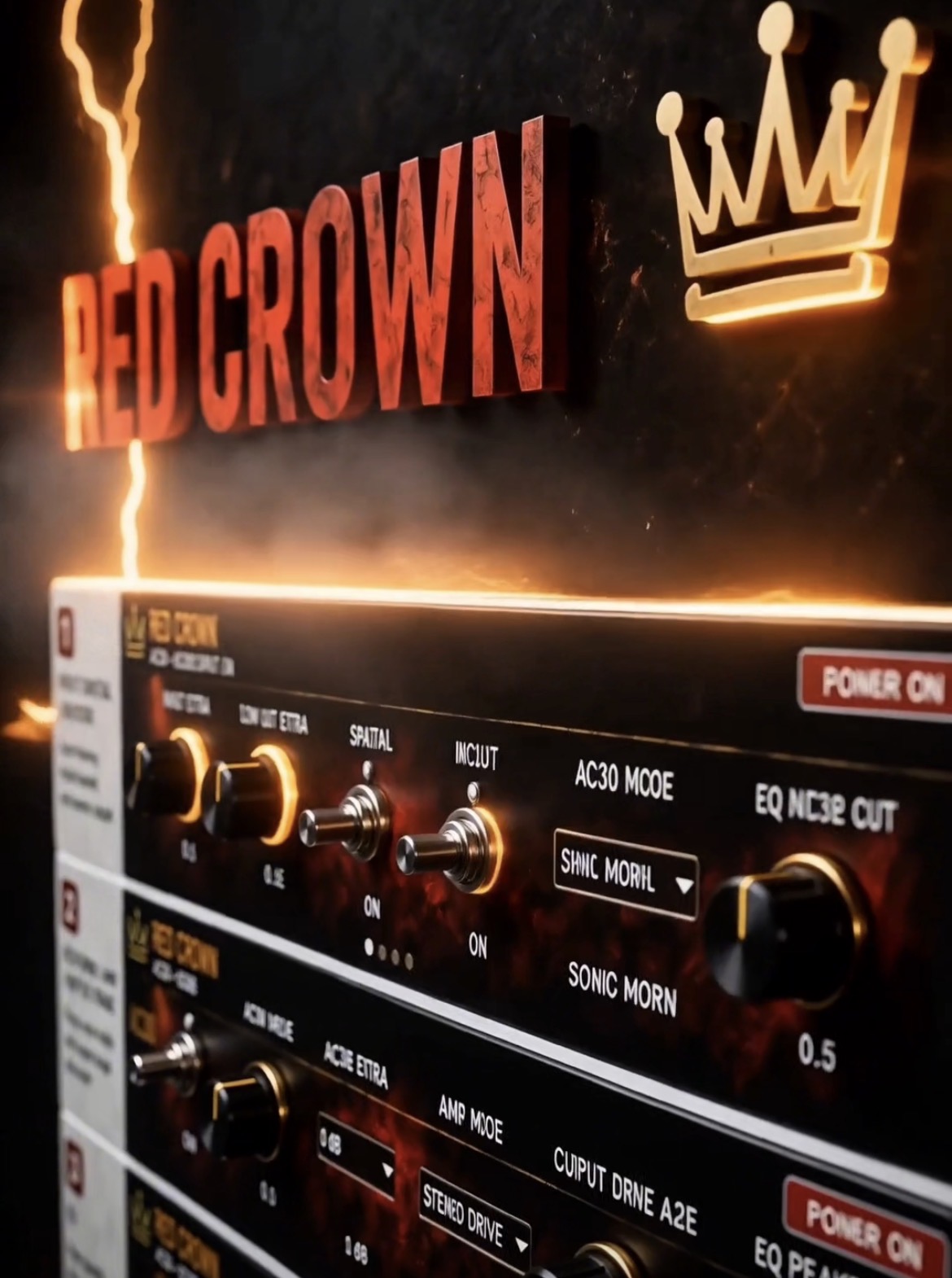
RED CROWN 1.0
Fast controls, immediate response and a complete guitar sound without assembling a long plugin chain.
PLUGIN FOR ANAGRAM
A dedicated LV2 build brings the RED CROWN signal chain to the Darkglass Anagram ecosystem.
VIEW IN ANAGRAM MARKETPLACE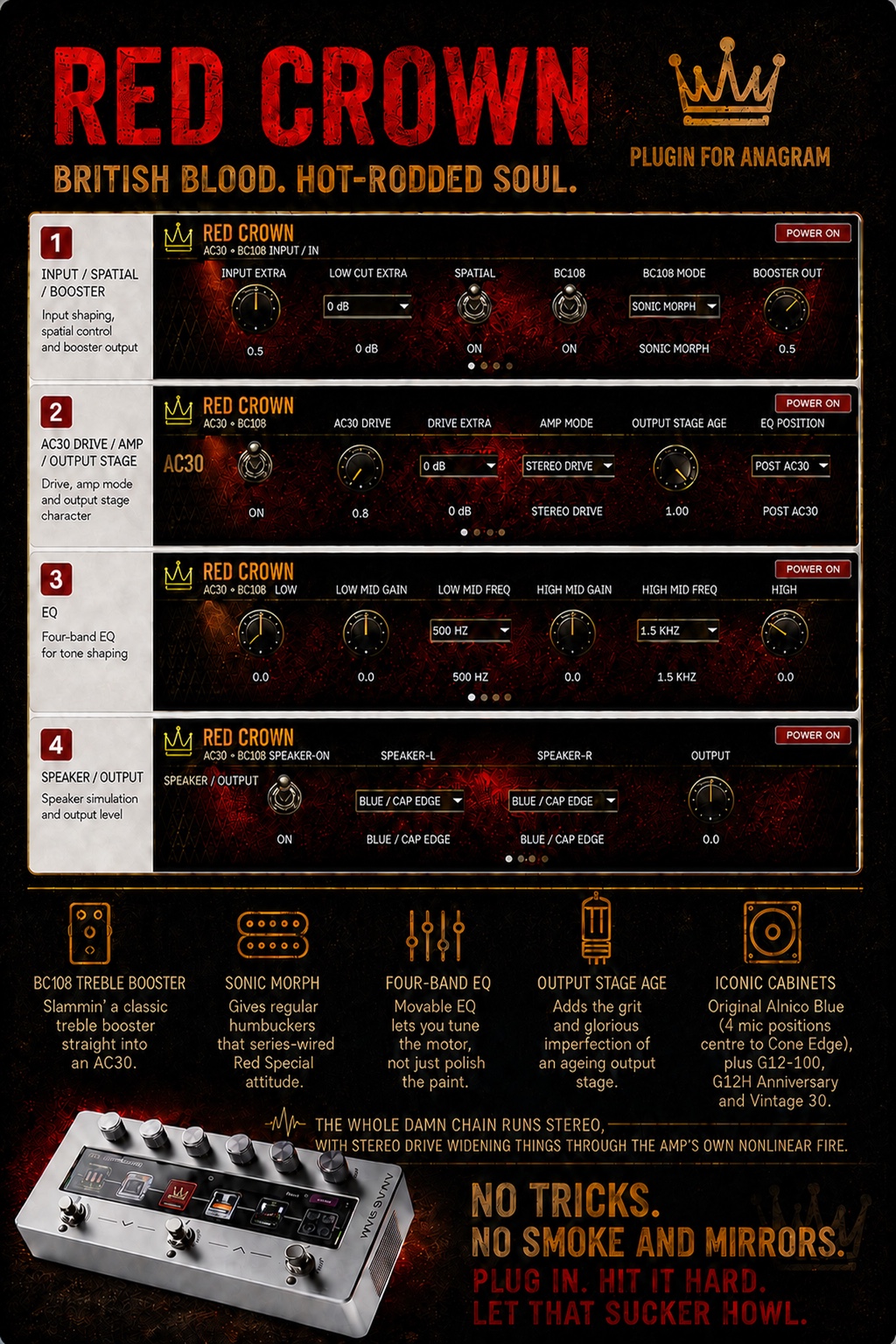
FAQ
The RED CROWN VST3 plugin for Windows and your personal license file.
After purchase you receive a personal redcrown.lic by email. Import it once in RED CROWN; verification is local afterwards.
No. RED CROWN uses its own lightweight offline license system.
No. €79 is a one-time purchase.
READY?
VST3 for Windows. One-time purchase. The personal RED CROWN license is imported locally and verified offline — no iLok, dongle or permanent internet connection is required after activation.
After purchase you receive the plugin download and your personal redcrown.lic. Use IMPORT LICENSE inside RED CROWN to activate the full version.
Import your personal redcrown.lic directly in the plugin. Verification is performed locally.
No. RED CROWN uses its own local license-file system.
No permanent internet connection is required for the plugin after the license has been imported.
The direct-sale release is RED CROWN VST3 for Windows.
One-time purchase · VST3 for Windows · Immediate download · Personal license by email