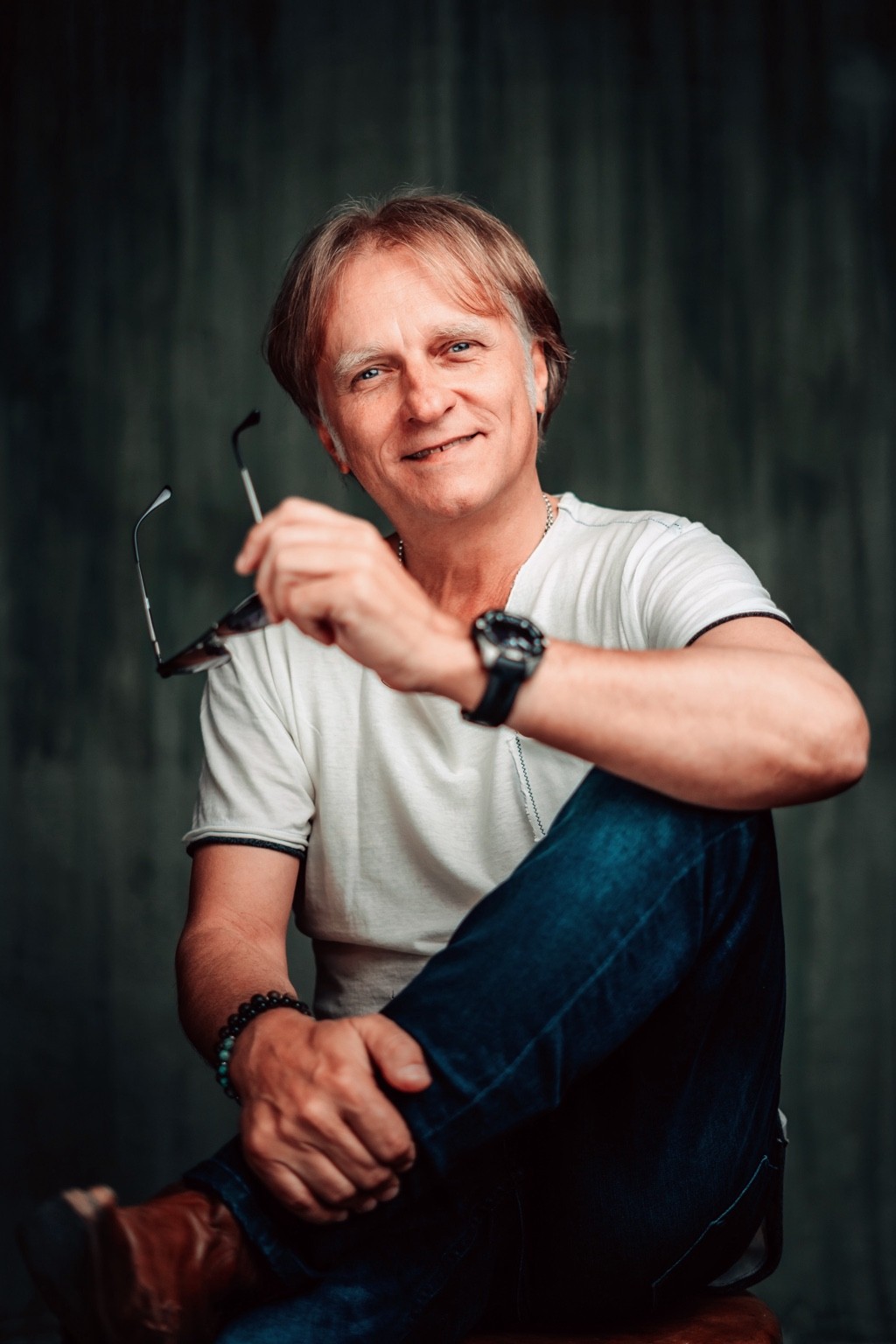
My name is Stephan Möller. I was born in Germany in 1962, and as a musician, songwriter and audio developer I work under the name Steve Sledge.
RED CROWN did not begin in 2026.
In many ways, the story began almost fifty years earlier.
I started playing guitar at the age of thirteen. By around fourteen or fifteen, I had already become fascinated by how the sound of an electric guitar was created — and, above all, how it could be changed.
One of my first experiments was about as simple as it gets: an operational amplifier driven into clipping. It distorted. And it sounded pretty awful.
But that may have been the first important lesson on a path that still occupies me today: distortion alone does not make a great guitar tone.
Those experiences deepened my interest in valve amplifiers and in a question that would stay with me: why could different amplifiers react and sound completely different even when producing apparently similar amounts of distortion?
In 1982 I worked as an assistant at Nordland Musik (Zinngrebe) in Hamburg. With the help of the shop's technician, I assembled a Mesa/Boogie Mark I from available spare parts.
A year later I worked at Amptown in Hamburg. By then I was becoming increasingly interested in Queen and, in particular, Brian May's guitar sound. At my request, the technician there built me a small British-style valve amplifier using two EL84 output valves and a single loudspeaker.
1982–1983 — learning from real amplifiers
1984 — the guitar was part of the system too
In 1984 I built my first guitar.
I started with a Rockinger kit and turned it into my own version of Brian May's Red Special, fitted with three Burns Tri-Sonic pickups.
Even then, I was beginning to realise that it made little sense to think of the guitar, booster, amplifier and loudspeaker as completely separate things.
The sound came from the whole system.
1984/85 — my own AC30
At around the same time, when I was about twenty-two, I bought my own 1961 Vox AC30.
I later used it with a resistive power soak between the output stage and the loudspeakers.
At first this was mainly practical: the amplifier was loud, and the old speakers needed protection. Looking back, however, the experience became important for another reason.
I was already exploring how a heavily driven valve output stage sounded and responded — and how much of the final result came from the loudspeaker that followed it.
That separation would reappear decades later in RED CROWN.
Training, electronics and the first models
In 1987 I completed my qualification as a radio and television technician.
That gave the experiments I had been making for years a much firmer foundation in electronics.
I worked with bipolar transistors, later with FETs, diodes and operational amplifiers, and gradually stopped thinking in terms of simply building a good distortion pedal. I wanted to reproduce an amplifier.
For me, that also included the loudspeaker. I therefore developed an analogue speaker simulation using fixed inductors and capacitors.
Even then, the goal was a system capable of producing a repeatable guitar sound without having to record a large, loud valve amplifier with a microphone every time.
1995 — communications engineering
In 1995 I graduated as an electrical engineer, specialising in communications engineering.
During my studies, including practical work at Philips, I encountered MATLAB.
That opened up an entirely new possibility: the processes inside an amplifier no longer had to be reproduced only with physical electronic components. They could be described mathematically, analysed and eventually calculated digitally.
But for the time being, I continued working in analogue.
1996 — the first multistage AC30SIM
In 1996 I completed my first FET-based multistage AC30SIM.
The word “multistage” is important.
I did not simply want to create a transfer curve that somehow sounded like valve distortion. My approach was to reproduce the different stages of the amplifier and their behaviour one after another.
What had started with a single clipping op-amp had become a fundamentally different idea of amp modelling: not simply reproducing the distortion, but reproducing the signal path that creates it.
2002 — moving into the digital domain
Around 2002 I met Professor Udo Zölzer.
That marked the decisive transition from my analogue models to digital signal processing.
One important challenge was the valves themselves. The general-purpose SPICE valve models available to us at the time did not appear accurate enough for what we wanted to achieve, so the valve characteristics were measured directly.
The individual amplifier and filter stages, including their interactions, were then modelled. The phase-splitter stage proved particularly demanding because of the interacting valve systems, capacitors and grid currents.
2004 — TC Thirty
This work eventually led to collaboration with TC Works / TC Electronic.
In 2004, TC Thirty was released for the PowerCore platform. The amplifier, treble booster and loudspeaker were brought together within a DSP system.
For me, this was a major milestone. Something I had spent years trying to achieve with transistors, FETs, diodes, op-amps, resistors, capacitors and inductors now existed as a real-time DSP model.
Looking back, TC Thirty brought together several ideas that would continue to interest me for decades: the interaction of booster, amplifier and loudspeaker, and the idea of modelling a complete guitar signal path rather than a single distortion stage.
More than two decades later, those ideas have evolved considerably. RED CROWN grew from a new generation of software and algorithms and expands the concept in many directions: an independently adjustable BC108 booster, a considerably evolved multistage amp model, Output Stage Age, a movable four-band EQ, multiple speaker models and virtual microphone positions, Sonic Morph, true stereo processing, Spatial Stereo and Stereo Drive. On Anagram, these elements become part of a flexible rig whose parameters can change from Scene to Scene.
The technology changed enormously. The fascination behind it did not.
2006 — VPD1
In 2006, VPD1 became another analogue branch of this work.
It used my multistage AC30SIM approach based on FETs, operational amplifiers and diodes, and developed in connection with my work with TC.
At that point, analogue and digital modelling were not competing philosophies to me. They were simply two different ways of investigating the same problem.
My introduction to Analog Devices SigmaStudio
I have worked at Helmut Schmidt University in Hamburg since 2003. During my work there, I later examined the ZT Lunchbox and ZT Club guitar amplifiers.
That was my first encounter with Analog Devices SigmaStudio and the ADAU1701 used inside those amplifiers.
This introduction to the SigmaDSP platform became important for my later guitar projects. It eventually led me to more powerful SigmaDSP processors and to my own embedded systems.
The next problem: the platform
Over the years, the question gradually changed. By then I had a clear idea of how I wanted to model the amplifier structures themselves.
The problem increasingly became: where do I run them?
Powerful DSPs and increasingly capable digital guitar systems existed, but implementing my own system usually meant building hardware, integrating it and doing a considerable amount of programming around the actual audio algorithm.
What I was really waiting for was a guitar platform that was both powerful and open to third-party development.
2007 onwards — songwriting and music production
In 2007, I began writing my own songs, adding another path alongside the technical work that had occupied me for decades.
In 2019, I began releasing my music as Steve Sledge, with my first album released through The Orchard. Further releases followed; between 2023 and 2025 I released three albums and EPs, available through platforms including Spotify and Apple Music.
Over time, songwriting and music production also changed the way I looked at guitar technology. I was no longer developing amp models only from an engineer's perspective. I was also using them as a guitarist, songwriter and producer in my own recordings.
The technical questions still mattered. But so did some very practical ones: Does the sound inspire me to play? Does it work in a recording and in a mix? And can I get where I want without fighting the technology?
That musician's perspective ultimately became just as important to RED CROWN as the modelling technology behind it.
Technically, that was fascinating. But it also made something increasingly clear: I did not want to spend most of my time developing the hardware platform around the sound. I wanted to develop the algorithm.
By then I had implemented my amp algorithms in very different forms: analogue hardware, DSP, an embedded system inside a guitar and dedicated digital pedals.
From 2017 onwards I used increasingly powerful SigmaDSP processors for my own guitar projects, first in a dedicated pedal and later in an embedded system inside my Gibson BluesHawk. I eventually transferred the approach back into a standalone digital pedal.
2017–2021 — building my own embedded guitar systems
2026 — Anagram
In 2026 I finally bought a Darkglass Anagram.
And suddenly something was different.
For the first time, I had a compact guitar platform in front of me that offered exactly the direction I had been waiting for: powerful real-time processing and the possibility of running my own plugin development on an existing platform built for musicians.
That finally allowed several lines of development I had been pursuing for decades to come together in a practical way.
RED CROWN
That is where RED CROWN came from.
For me, RED CROWN is therefore not simply a software recreation of one particular historic amplifier.
At the heart of the amp model is the amplifier architecture I have been exploring for decades: a direct British valve signal path with no tone stack inside the amp model, a phase splitter, a four-EL84 push-pull output stage and an output transformer.
The output stage is deliberately modelled into a resistive load. This allows its nonlinear behaviour to remain separate from the frequency-dependent characteristics of the loudspeaker selected afterwards.
The BC108 Booster remains its own nonlinear system. The speaker section is independent. The four-band EQ can be placed at different points in the signal chain.
Output Stage Age changes aspects of the push-pull output-stage behaviour. Spatial Stereo and Stereo Drive create differences between the left and right signal paths without turning the result into an obvious chorus or delay effect.
Sonic Morph even returns to a question that interested me in the early 1980s: how the guitar and pickup system influence the way the booster and amplifier are driven in the first place.
Why not just NAM?
Neural Amp Modeling has demonstrated how accurately complex amplifier behaviour can be reproduced using data-driven methods. NAM is also a valuable reference in my work today.
But at some point I realised that I wanted something different.
A NAM capture represents an amp state. I wanted the amplifier itself to remain adjustable.
The booster and amp should remain separate nonlinear systems. I wanted to be able to change the behaviour of the output stage. I wanted to change the loudspeaker without simultaneously replacing the underlying amp model. And on Anagram, I wanted those parameters to be changeable from Scene to Scene.
That made the purpose of RED CROWN clear: not simply to reproduce a sound, but to create an adjustable rig.
AI as an engineering tool — and a development buddy
RED CROWN was also developed at a time when a new kind of engineering tool had become available: artificial intelligence.
I want to be open about its role in the project. I used ChatGPT extensively while turning my ideas and models into a finished product — particularly for C++ implementation, VST3 and Anagram plugin integration, development tools, documentation and the website.
Without that assistance, I could not have implemented all of those parts within the same amount of time.
But AI did not provide the engineering history behind RED CROWN. The amplifier concepts, modelling approach, circuit knowledge, measurements, experiments and countless decisions about how the system should behave grew from decades of my own work with guitar electronics, analogue modelling and DSP.
For me, ChatGPT became more than just another software tool during development — it became something of a development buddy: a way to work through implementation problems, test ideas, document decisions and move between disciplines that would previously have required considerably more time or several specialists.
In that sense, RED CROWN is both the continuation of a very old personal project and the product of a very new way of working.
The ideas took decades to develop. AI helped me turn them into a finished product much faster.
Almost fifty years later
Looking back today, RED CROWN feels less like a new invention than a point where many different paths finally meet.
The technical tools have changed repeatedly over all those years.
The question behind them really has not.
I wanted to understand why a particular guitar sound can feel so alive, dynamic and immediate — and how that behaviour can be reproduced without losing the very qualities that made it worth reproducing in the first place.
Almost fifty years after my first experiments, RED CROWN is the latest point on that journey.
RED CROWN is where all those paths finally meet.
Historical note
This text describes my personal development and engineering history. References to third-party artists, manufacturers and products are included solely to provide historical context for my influences, equipment and earlier development work. RED CROWN is an independently developed Steve Sledge Audio product; no endorsement, authorisation or business affiliation by the third parties mentioned is implied. Third-party trademarks and product names remain the property of their respective owners.